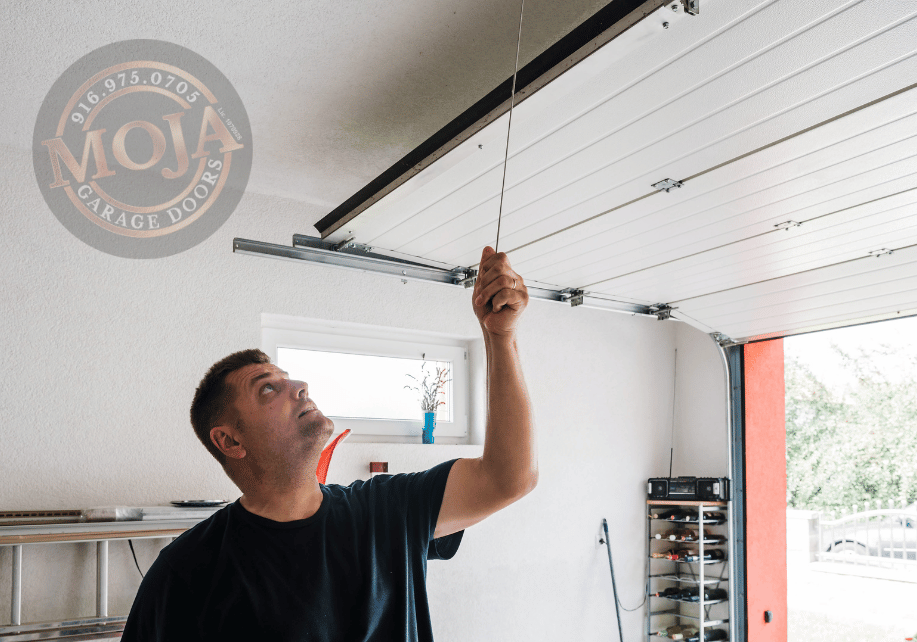
Yes, some garage door maintenance tasks are genuinely safe for homeowners to handle, and doing them consistently makes a real difference in how the door performs and how long the components last. The honest answer depends on which part of the system you are working on.
We walk every customer through the maintenance steps they can safely handle before we leave a job. Someone who knows what to look for catches problems earlier and gets more life out of every component in the system. But there is a line in garage door maintenance that exists for a specific reason, and understanding where it falls is just as important as knowing what to do on the safe side of it.
What Homeowners Can Safely Handle
Garage door maintenance has a homeowner-safe side that covers four areas: visual inspection, lubrication, the auto-reverse test, and the balance test. Done consistently, these tasks address the most common causes of premature wear and keep everything running the way it was designed to.
Visual Inspection: Monthly
Walk the full perimeter of the door system with the door in the closed position. You are looking at the cables, rollers, tracks, and bottom seal. On the cables, look for fraying, kinking, or any slack that was not there before. On the rollers, look for cracking or flat spots that indicate the roller is no longer making proper contact with the track. On the tracks, look for visible bends and check that the mounting brackets are flush against the wall with no gaps. On the bottom seal, check that it is making full contact with the floor across the entire width of the door.
The spot most homeowners miss is where the cable attaches at the bottom bracket. That connection point takes significant load every time the door cycles, and early fraying there is easy to overlook. This inspection takes less than five minutes and is the single most effective thing a homeowner can do between professional visits.
Lubrication: Every Six Months
The components that need lubrication are the hinges, rollers, and the torsion spring. Use a spray-on lubricant specifically formulated for garage doors. DASMA, the Door and Access Systems Manufacturers Association, recommends using a spray-on lubricant designed for garage doors as the first step when a door begins making noise, and the same product is what you should be applying during routine maintenance, not just when something sounds wrong.
Do not use WD-40. It is a solvent, not a lubricant, and it displaces the existing lubrication rather than supplementing it. The result is a door that runs quieter for a short time and then dries out faster than it would have otherwise.
One of the most common mistakes we see on first-time maintenance calls is lubricant applied directly to the tracks. The tracks are not meant to be lubricated. They are designed to give the rollers a dry surface to roll against. Lubricating them causes the rollers to slip, which creates uneven movement and puts stress on the hardware around the affected section.
In Sacramento, the standard recommendation of lubricating once a year is not enough. The Central Valley heat between June and September accelerates lubricant breakdown at a rate that a mild-climate maintenance schedule does not account for. A door lubricated properly in March can be running dry by July. Lubricating twice a year, once in spring before the heat sets in and once in fall before temperatures drop, is the schedule that actually fits Sacramento’s climate.
Auto-Reverse Test: Monthly
Since January 1, 1993, federal law under the Consumer Product Safety Improvement Act of 1990 has required all residential garage door openers to comply with UL 325, the Underwriters Laboratories safety standard mandating auto-reverse mechanisms on every opener. Every opener manufactured after that date must reverse the door upon contact with an obstruction.
Testing this takes two minutes. Place a 2×4 flat on the ground in the center of the door opening. Press the close button and stand clear. The door should contact the board and reverse immediately. If it does not, the opener’s close-force setting needs recalibration. That adjustment is a technician task, not a homeowner one, but running the test monthly is something every homeowner should be doing regardless of how new the opener is. Sensors drift. Settings shift over time. A door that passed the test six months ago may not pass it today.
Balance Test: Every Six Months
Disconnect the opener by pulling the red emergency release cord, then manually lift the door to about waist height and let go. A properly balanced door will stay in place or drift only slightly in either direction. If it drops quickly or shoots upward when you release it, the torsion spring system is out of balance.
A door that fails this test is not just a routine maintenance flag. It means the opener has been compensating for an imbalanced spring system on every cycle, which accelerates motor wear and puts strain on the cables and hardware. The balance test tells you whether something is wrong. What is causing the imbalance requires a professional to diagnose and correct.
What Homeowners Should Not Attempt
The tasks above are homeowner-safe because they involve observation, lubrication, and testing without putting hands on any load-bearing components. The tasks below are not homeowner-safe for the opposite reason.
Torsion springs store mechanical energy under significant tension at all times, including when the door is closed and sitting still. DASMA states directly in its published safety guidelines that springs are under high tension and that only qualified individuals should adjust them. This is not a precaution that applies only to broken springs. It applies to any adjustment, including minor tension corrections that look straightforward from the floor. A torsion spring that releases its stored energy unexpectedly during an adjustment causes severe injury. This is a professional-only task without exception.
Cable adjustment and re-routing carry the same risk. The lift cables are connected to the torsion spring system and remain under load even when the door is not moving. Accessing a cable for adjustment requires releasing spring tension first, which puts you in contact with the most dangerous component in the system before the cable work even begins.
Track realignment is another task that looks simpler than it is. A track that has bent or shifted did so because of a force that the system applied to it over time. Bending it back without identifying what caused the shift does not fix the problem. It gives the appearance of a fix while leaving the underlying cause in place, which means the track will shift again and the wear it was causing will continue.
If the monthly auto-reverse test fails, the close-force calibration on the opener needs adjustment. While some openers provide homeowner access to these settings, an incorrect adjustment creates a door that does not reverse when it should. The consequence of getting that wrong is more dangerous than the original failed test. Have a technician recalibrate it.
What a Professional Visit Covers That a Self-Inspection Cannot
A homeowner who runs through the four tasks above consistently is ahead of most. But there are things a trained technician assesses during a professional garage door maintenance visit that are not replicable through self-inspection.
Torsion spring tension assessment requires hands-on adjustment to determine whether the spring is at the correct tension for the door’s current weight. A spring that is slightly under or over tension affects the door’s balance, the opener’s load, and the cycle life of the hardware in ways that are not visible from a distance. Getting it right requires working directly with a loaded component.
Cable condition at the drum is another area where professional assessment matters. The point where cables experience the most stress is where they wrap around the drum at the top of the door. Assessing whether a cable is approaching the end of its serviceable life requires getting close to a component that should only be handled by someone with the right tools.
We have been doing this work in Sacramento since 2006, and every maintenance visit ends the same way: walking the homeowner through what we found, what we adjusted, and what to watch for before the next visit. Understanding the system is what helps you catch problems earlier, which is exactly the point.
The Right Maintenance Approach Is Both
Consistent homeowner maintenance and an annual professional visit are not substitutes for each other. The four tasks covered here are genuinely valuable and worth doing every time. The professional visit covers components that require hands-on adjustment of load-bearing parts, and together they are what keeps a door running quietly and safely.
MOJA Garage Doors has been handling professional garage door maintenance visits for Sacramento homeowners since 2006. Our California Door and Gates license (CA #1070928) reflects our commitment to meeting applicable state licensing requirements. We serve Sacramento, Elk Grove, Roseville, Folsom, Rancho Cordova, and the surrounding Sacramento communities. Call (916) 975-0705 to schedule your maintenance visit.