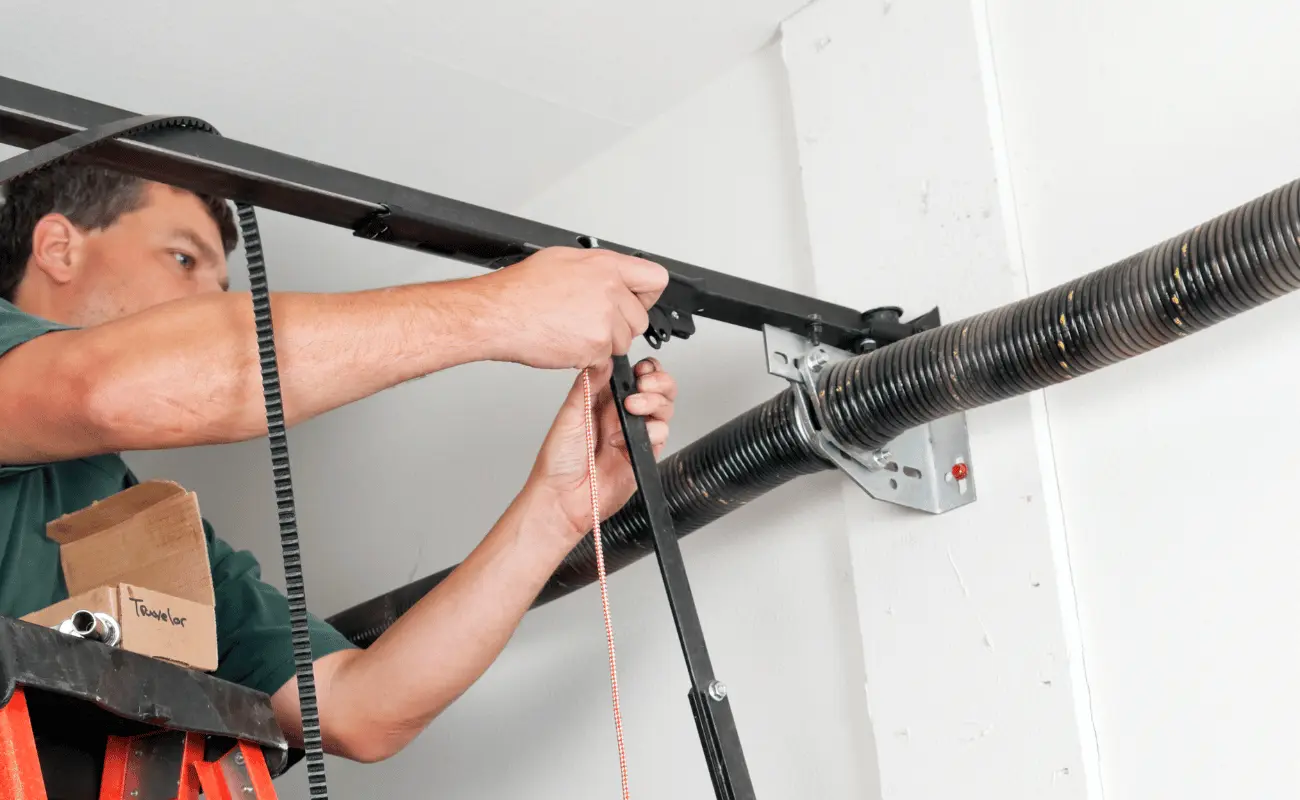
Most homeowners notice something is off before a garage door cable fully fails. The door moves a little slower than usual. One side looks slightly lower than the other. The opener sounds like it is working harder than it should. These are not coincidences. They are early warnings that the cable system is compromised, and in our experience, homeowners who ignore them end up facing a repair two or three times more involved than it needed to be.
A garage door cable repair feels easy to put off. The door is still moving. Nothing has completely stopped. But what is happening inside the system while you wait is exactly what this post is about.
What Garage Door Cables Actually Do
Your garage door system has two types of cables working together. Lift cables do the heavy work. They wrap around drums mounted on the torsion bar above the door, and as the spring unwinds its stored tension, the cables transfer that force to raise the door. On extension spring systems, safety cables run through the center of each spring. If a spring snaps under load, the safety cable keeps it from becoming a projectile inside your garage.
Both cable types are load-bearing components. A standard two-car garage door weighs between 150 and 250 pounds depending on the material, and the cable system is what makes that weight manageable for your opener motor. The moment a cable starts to fail, that load does not disappear. It redistributes, and everything connected to the cable system starts absorbing stress it was never designed to handle.
Here is something most homeowners do not realize: cables that look fine from across the garage are often already fraying where they wrap around the drum. That contact point is where the wire experiences the most repeated stress, and it is not visible without getting close and inspecting the coil directly. By the time fraying becomes obvious from a distance, the cable is well past the point where it should have been replaced.
The Chain Reaction You Do Not See Coming
Ignoring a cable issue does not pause the problem. It starts a sequence of damage that moves through the entire door system faster than most people expect.
The Door Loses Its Balance
A garage door is engineered to move as a single, balanced unit. When one cable weakens or separates, the door can no longer distribute its weight evenly across both sides. One side drops. The door begins to tilt inside the track. The track on the low side absorbs lateral force it was never rated for, the rollers begin to bind, and the door starts to jerk and shudder on every cycle instead of moving smoothly.
We have gone out to jobs where a homeowner reported a noisy door and assumed the tracks needed adjustment. In several of those cases, the tracks were fine when the cable issue started. By the time we arrived, the tracks had taken enough uneven load that they needed to be addressed alongside the cable. The original repair had doubled in scope simply because the door kept being used.
The Springs Start Working Against Themselves
Torsion springs and lift cables are calibrated to work together. The spring stores mechanical energy and releases it through the cable system in a controlled way. When a cable fails or goes slack, that calibration breaks down. The functioning spring continues to release tension, but without a properly tensioned cable to transfer the load, the force has nowhere to go efficiently. The result is a spring cycling under conditions it was not set up for, which accelerates wear on the spring wire and shortens the lifespan of the entire spring system.
We consistently find this pattern on service calls where a cable issue was left too long. By the time the cable gets replaced, the springs need to be inspected and often adjusted or replaced as well. What could have been a cable-only repair becomes a cable and spring repair. This is not an upsell. It is the mechanical reality of what happens when one load-bearing component fails and the others are forced to compensate.
The Opener Motor Pays the Price
Your garage door opener is rated to lift a properly balanced door. It is not built to compensate for a mechanical failure in the cable system. When the door is unbalanced, the opener motor works harder on every cycle to move a load that is fighting it from one side. That extra strain shows up first as sluggishness, then as unusual sounds from the motor unit, and eventually as a motor that burns out well ahead of its expected lifespan.
This is a pattern we see regularly on calls where the homeowner believed the opener was the problem. In those situations, the opener was responding to a cable issue quietly building for weeks or months. The opener gets replaced, the cable issue goes undiagnosed, and the new motor experiences the same strain. Diagnosing the root cause is the only way to stop the cycle.
The Door Can Drop Without Warning
This is the consequence most homeowners do not think about until it happens. A cable that has been fraying progressively does not always give a clear final warning before it separates. When it goes, one side of the door loses all mechanical support instantly. The door drops with significant force and lands on whatever is beneath it at that moment.
We have responded to calls after this exact scenario, a vehicle hood damaged, a threshold crushed, and in one case a door that came down while someone was walking beneath it. DASMA, the Door and Access Systems Manufacturers Association, states directly in its published safety guidelines that frayed or worn cables are in danger of breaking and can cause injury, and that due to the dangers associated with high spring tension, cables should be replaced only by a trained technician. ANSI/DASMA 110-2025, the governing standard for lifting cables on sectional doors, exists precisely because this is not a component category where wear can be tolerated. A fraying cable is not something to monitor. It is something to replace.
This is also why garage door cable repair is a professional-only service. The cables are under load even when the door is sitting still because the spring tension they are connected to never fully releases. Releasing that tension safely requires specific tools and the training to use them correctly. Attempting to re-route or re-tension a cable without both is one of the most common causes of serious injury in residential garage door service.
What to Watch for Before It Gets to This Point
You do not need to be a technician to recognize when a cable issue is developing. If one side of your door sits visibly lower than the other when closed, that is a cable system problem until proven otherwise. If the door jerks or hesitates in a way it did not before, the cable system should be the first thing a technician checks. A cable that looks slack, kinked, or has come away from the drum needs immediate attention. The same applies if your opener sounds like it is straining on the way up, or if the door moved faster than usual on the way down and did not stop where it normally does.
Any one of these signs is enough to stop using the door and make the call. Using a door that is showing these symptoms does not just risk making the repair more expensive. It risks making it dangerous.
Why We Always Inspect the Full System
When we go out on a garage door cable repair call, we do not just look at the cable. We inspect the drums, the spring system, the track alignment, the hardware condition, and the opener’s response to a balanced load. Cables rarely fail in isolation. There is almost always a contributing factor, a drum that developed an edge, a spring that lost tension on one side, or a track that shifted enough to create uneven load on the cable wrap.
Finding that contributing factor is what separates a repair that holds from one that comes back in three months. We have been doing this work in Sacramento since 2006, and that approach applies to every call regardless of how straightforward it looks. Our California Door and Gates license (CA #1070928) reflects a standard of practice we take seriously on every job.
The Cost of Waiting Is Always Higher
A cable repair addressed at the first warning signs stays a contained, straightforward job. The same repair ignored for weeks becomes a cable, spring, track, and potentially opener repair. We have seen both versions many times, and the difference in scope is significant every time.
If your door does not feel right, get a technician out before the system makes the decision for you. MOJA Garage Doors serves Sacramento, Elk Grove, Roseville, Folsom, Rancho Cordova, and surrounding areas. Call (916) 975-0705 to schedule your free on-site assessment.